
The Five Pillars of The POWER Framework® for Empowered, High-Performing Teams

Updated: Aug 4
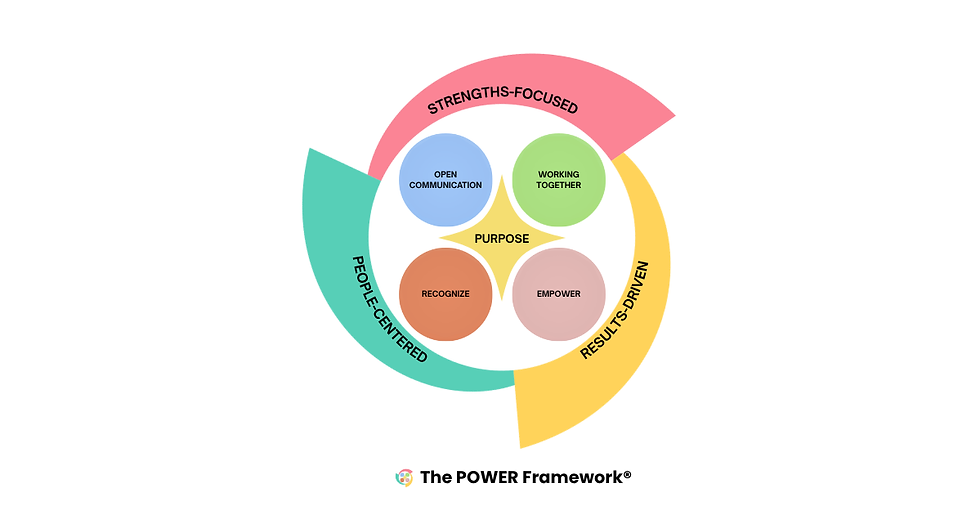
Organizations today encounter growing challenges related to employee engagement, collaboration, accountability, and retention. The POWER Framework® was designed to tackle these issues by assisting leaders and managers in fostering cultures where individuals flourish while achieving significant outcomes. This framework is founded on three guiding principles - Strengths-Focused, People-Centered, and Results-Driven - and is articulated through five pillars: Purpose, Open Communication, Working Together, Empower, and Recognize.
When these pillars are intentionally practiced, teams develop trust, ownership, engagement, and sustainable performance.
In my previous blog post, we examined the three guiding principles of The POWER Framework®:
Strengths-Focused: Build on Team's Unique Contributions - Their Talents Turn into Strengths
People-Centered: Put People at the Heart of Success
Results-Driven: Delivering Value With Accountability and Ownership
We are now transitioning to the five pillars of The POWER Framework®: Purpose, Open Communication, Working Together, Empower, and Recognize.

Purpose
The sense of being part of something greater than yourself can lead to high levels of engagement, high levels of creativity, and the willingness to partner across functional and product boundaries within a company, which are hugely powerful. - Rebecca Henderson, the John and Natty McArthur University Professor at Harvard Business School
Purpose lies at the core of the framework, acting as the driving force for all other pillars. Without purpose, there is a lack of direction. Without purpose, there is lack of engagement, productivity and satisfaction.
Purpose at work, as defined by Meridian University, is the intrinsic sense of fulfillment that employees gain from doing work that has meaning. Alignment of personal and organizational values can drive engagement, productivity, and satisfaction. Engaged team members are more present, productive, and conscious of the importance of their role and their effectiveness (Meridian University, 2023).
According to the global survey that Harvard Business Publishing Corporate Learning conducted, 90% of the respondents said that work should bring a sense of meaning to their life (Harvard Business Publishing Corporate Learning, 2022). This research suggests that employees want their jobs to be meaningful, but most struggle to live their purpose at work - and disengage as a result.
There is a gap on purpose at work between executives/upper management and frontline managers/employees. While 85% of executives and upper management report that they are living their purpose at work, merely only 15% of frontline managers and employees agree. This purpose gap between executives and their teams is leaving most members of the workforce in a state of disengagement (Harvard Business Impact, 2025).
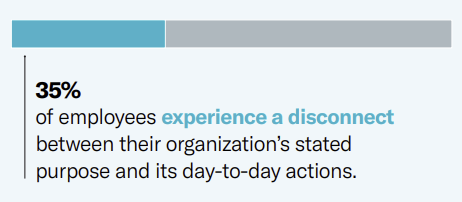

Source: Harvard Business Impact (2025)
Closing this purpose gap brings substantial benefits not only to the company but also to the employees. From the information collected by Harvard Business Impact, we can see that:
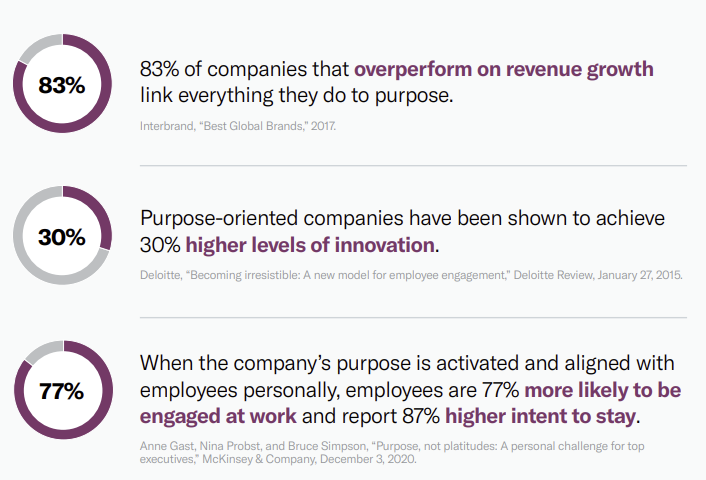
Source: Harvard Business Impact (2025)
Purpose is also supported by Self-Determination Theory (SDT), developed by Edward Deci and Richard Ryan. SDT suggests that people thrive when work satisfies three fundamental psychological needs:
Autonomy (choice and ownership)
Competence (mastery and growth)
Relatedness (connection and belonging)
When team members connect their daily work to a meaningful purpose, intrinsic motivation increases substantially.
Now, let's connect the guiding principles within Purpose:
Strengths-Focused
How can you connect the purpose or goals to your team's strengths? When the purpose is aligned, and team members understand how their strengths contribute to achieving it, it becomes personal, fostering a sense of ownership. This approach makes the team feel valuable, as you are leveraging their unique contributions - their talents transformed into strengths - to deliver value towards the purpose and goals.
People-Centered
Integrate wellbeing, emotional intelligence and psychological safety into your purpose. Purpose extends beyond achieving outcomes; it's a culture that needs to be cultivated and fostered. By incorporating wellbeing, emotional intelligence and psychological safety into your team's purpose and goals, you can enhance engagement and foster a sense of care, which is crucial for the team.
Moreover, connect organizational goals to personal values and aspirations. When the team members able to see the connection between their personal values/aspirations and the organizational goals, it develops sense of ownership and interest.
Results-Driven
Develop objectives and key results that align with the purpose. The purpose provides the reason why, whereas the objectives and key results define what we aim to achieve and how we will achieve it. Make sure that the purpose, objectives, and key results are clearly communicated and understood by the team. And there is a regular review progress and celebrate milestones.
Key Insight People commit more deeply when they understand not only what they do, but why it matters. |
Open Communication
In teamwork, silence isn’t golden, it’s deadly. - Mark Sanborn, Leadership Speaker and Best Selling Author
Open communication is essential for building trust. It entails creating a safe environment where team members can express and share their ideas and thoughts without fear of judgment. This fosters a culture of understanding, enabling individuals to feel recognized and listened to.
According to the study conducted by 15Five, more than 80% of the employees would rather work for an organization that values open communication than one that only offers perks like free meals and great health plans (Harvard Business Review, 2025).
Moreover, organizations who value open communications seen improvements in the following areas:
Better employee engagement
Greater team alignment
Stronger independent decision making
Improved teamwork and collaboration

Amy Edmondson's research on Psychological Safety demonstrates that high-performing teams succeed when individuals feel safe speaking up, asking questions, admitting mistakes, and sharing concerns without fear of embarrassment or punishment. Google's Project Aristotle similarly identified psychological safety as a key factor in team effectiveness.
Now, how can we build a culture of open communication in our teams and/or organizations?
Let's start with the checklist for effective communication - the 7 Cs of Effective Communication:
Clear - Be clear about the goal and purpose of your message.
Concise - Keep to the point and keep your message short and simple.
Concrete - Be clear, not fuzzy. Provide detail, but not too much detail.
Correct - Make sure your message is accurate and grammatically correct.
Coherent - Make sure your message flows well and laid out logically.
Complete - Ensure the recipient has everything they need to understand.
Courteous - Your message should be polite, friendly, professional and open.
This checklist provides managers or leaders with guidance on how effectively they communicate the message to their team. For additional information, please visit https://www.revolutionlearning.co.uk/article/the-7-cs-of-communication/
Using the three guiding principles of The POWER Framework, here are the practical guidelines on how we can build a culture of open communication in our teams/organizations:
Strengths-Focused
Encourage each team member to consider how they can utilize their strengths to enhance clear communication. By leveraging their strengths, they can naturally develop their communication skills.
Help team members understand one another's communication preferences.
Encourage strengths-based feedback conversations.
Use strengths language to discuss challenges and opportunities.
People-Centered
Create a culture of psychological safety where every team member is heard.
Practice active listening.
Start meetings with personal check-ins.
Demonstrate empathy and curiosity.
Encourage equal participation.
Ask before assuming.
Results-Driven
Setup Communication Plan with the team. Clearly indicate the roles and responsibilities of the team in terms of Communication. Include metrics as well for team alignment. Clarify communication expectations and establish feedback loops.
Share progress updates consistently.
Communicate and address issues early before they escalate.
Key Insight Open communication creates a culture of trust and understanding that results to lower stress, higher productivity, greater engagement, less burn-out and more energy at work. |
Working Together
Coming together is a beginning; keeping together is progress; working together is success. - Henry Ford, Founder of the Ford Motor Company
Working Together means intentionally fostering collaboration, partnership, and shared accountability across individuals and teams.
Collaboration becomes significantly stronger when people understand and appreciate one another's strengths. Gallup's strengths-based research demonstrates that teams that know and leverage each other's talents experience stronger engagement and effectiveness.
Patrick Lencioni's work on team effectiveness identifies trust as the foundation for healthy collaboration, commitment, accountability, and results. Meanwhile, psychological safety research shows that teams solve problems more effectively when members feel comfortable contributing diverse viewpoints.
We can see a strong link between Purpose, Open Communication, and Collaboration. Collaboration is more effective when Purpose and Open Communication are present within the team. This is further enhanced by Empower and Recognize.
How can we improve the Working Together within the team?
Strengths-Focused
Map team strengths to the goals. You can also consider The Best of Us tool by Gallup to gain understand of how the team can work together effectively by understanding their contributions and needs.
Assign work based on talent and capability.
Create a peer learning experience for members to learn from one another's strengths.
Develop Strengths Partnership.
People-Centered
Create a psychologically safe space for the team where:
They can share their mistakes without fear of judgment.
They can experiment without fear of retaliation.
They can share ideas and thoughts with respect.
They can experience inclusion and belonginess.
They can discuss and resolve conflicts.
Results-Driven
Collaborate with the team to develop their Ways of Working (WOW) tailored to the projects or tasks they are handling.
Ensure collaboration efforts are in line with team objectives.
Clearly define roles and responsibilities.
Set clear expectations, including delivery timelines, and secure commitments from team members. Guide the team towards accountability and understand the support they need to fulfill their commitments.
Align performance evaluations with both the team and individual members. Focus on measuring team outcomes, not just individual achievements.
Establish a clear escalation process for addressing risks.
Include employee engagement activities.
Encourage collective accountability.
Key Insight Great teams succeed when they start asking, "How do we win together?" |
Empower
If you want to build a ship, don't drum up people together to collect wood... but rather teach them to long for the endless immensity of the sea. - Antoine de Saint-Exupéry, French Aviator and Writer
Empowerment is providing people with the trust, authority, resources, and support necessary to make decisions and take ownership of outcomes.
Self-Determination Theory identifies autonomy as one of the most important drivers of motivation. People are more engaged when they feel trusted and have meaningful control over how they perform their work.
Research on transformational leadership indicates that leaders who motivate and empower their employees foster greater confidence, innovation, and dedication. Managers play a crucial role in this process, as Gallup research reveals that they have a significant impact on employee engagement and performance.
Here are few practical steps to empower the team based on the three guiding principles:
Strengths-Focused
Delegate responsibilities according to strengths.
Encourage team members to solve problems using their natural talents.
Invest in development opportunities.
People-Centered
Coach instead of micromanaging the team. Provide the necessary tools and support for them to be self-managing.
Encourage learning from mistakes.
Promote psychological safety - Inclusion, Learner, Contributor and Challenger Safety.
Build confidence through developmental feedback.
Results-Driven
Set clear expectations including decision-making boundaries.
Measure outcomes rather than controlling every activity.
Reinforce accountability alongside autonomy.
Key Insight People are more engaged when they feel trusted and have meaningful control over how they perform their work. |
Recognize
Always treat your employees exactly as you want them to treat your best customers. - Stephen Covey, Best Selling Author
Recognition is the intentional acknowledgment of individual and team contributions, achievements, effort, growth, positive behaviors and wellbeing.
Recognition is one of the most powerful drivers of engagement and retention. Gallup research consistently demonstrates that employees who receive meaningful recognition are more engaged and more likely to stay with their organizations.
In a recent Gallup workplace survey, employees were asked to recall who gave them their most meaningful and memorable recognition. The data revealed the most memorable recognition comes most often from an employee's manager (28%), followed by a high-level leader or CEO (24%), the manager's manager (12%), a customer (10%) and peers (9%). Worth mentioning, 17% cited "other" as the source of their most memorable recognition. (Gallup, Inc., 2024). Based on the survey, the most memorable types of recognition are:
Public recognition or acknowledgment via an award, certificate or commendation
Private recognition from a boss, peer or customer
Receiving or obtaining a high level of achievement through evaluations or reviews
Promotion or increase in scope of work or responsibility to show trust
Monetary award such as a trip, prize or pay increase
Personal satisfaction or pride in work
Positive Psychology research similarly suggests that acknowledging strengths and successes reinforces positive behaviors and contributes to individual flourishing. Dale Carnegie's research also emphasizes that genuine appreciation strengthens morale, trust, and commitment (Fromm, 2023).
Gallup's data reveal that the most effective recognition is honest, authentic and individualized to how each employee wants to be recognized.
Let's now look how we can practice recognition based on these three guiding principles:
Strengths-Focused
Include strengths-based language in your check-in discussions. Acknowledge the strengths an individual employs and how these have benefited the team.
Promote a culture of recognizing strengths within the team. When team members notice someone utilizing their strengths, acknowledge them.
Honor achievements that are based on strengths.
People-Centered
Develop a caring culture to support the wellbeing of the team.
Celebrate personal milestones.
Provide honest, authentic and individualized recognition.
Foster a culture of gratitude.
Results-Driven
Connect recognition to measurable outcomes.
Celebrate milestones and achievements.
Reinforce desired behaviors.
Acknowledge continuous improvement.
Key Insight Promote a culture of honest, authentic and individualized recognition and gratitude. Celebrate not only work achievements, but also personal milestones and learnings. |
Bringing The POWER Framework® Together
The POWER Framework® is more than a leadership model - it is a practical system for creating empowered, high-performing teams.
When leaders cultivate:
Purpose to create meaning,
Open Communication to build trust,
Working Together to strengthen collaboration,
Empowerment to unlock ownership, and
Recognition to reinforce value,
they create an environment where people thrive together.
Through its three guiding principles - Strengths-Focused, People-Centered, and Results-Driven - the POWER Framework® helps organizations transform everyday conversations into a culture of engagement, accountability, innovation, and sustainable success.
Discover Your Team's POWER
Every high-performing team starts with understanding where they are today.
The My Team POWER Survey helps leaders and managers identify their team's strengths, uncover opportunities for growth, and gain practical insights for building stronger, more engaged teams.
Gain a clear picture of how your team performs across the five pillars of the POWER Framework - and discover the next steps to becoming an empowered, high-performing team that soars beyond limits.
Reference:
Meridian University (2023, Nov. 4). Purpose at Work: How You Can Lead a Purpose-Driven Company. http://meridianuniversity.edu/content/purpose-at-work-how-you-can-lead-a-purpose-driven-company.
Harvard Business Publishing Corporate Learning (2022, Jul). Do you believe work should bring a sense of purpose to your life? LinkedIn.
Harvard Business Impact (2025, May). The Purpose Factor: Why Your
Talent Strategy (and So Much More) Depends on It. https://www.harvardbusiness.org/wp-content/uploads/2025/05/HBI_The-Purpose-Factor-Why-Your_Infographic_May2025.pdf
Deci, E. L., & Ryan, R. M. Self-Determination Theory. https://positivity.org/psychology/self-determination-theory
The Center for Leadership Studies (2024, Dec 18). Building Trust Through Open Communication. https://situational.com/blog/building-trust-through-open-communication/
Harvard Business Review (2023, May). Why Overhauling Internal Communications Could Be Your Greatest Revenue-Driver. https://hbr.org/sponsored/2023/05/why-overhauling-internal-communications-could-be-your-greatest-revenue-driver
PRWeb (2015, Mar. 10). 15Five Study Shows Employees Want Open Communication with Bosses - But Few Get It. https://www.prweb.com/releases/15five_study_shows_employees_want_open_communication_with_bosses_but_few_get_it/prweb12565921.htm
Revolution Learning & Development Ltd (2022, Jun. 26). The 7 Cs of Communication. https://www.revolutionlearning.co.uk/article/the-7-cs-of-communication/
The Learner Lab. Better Leadership & Learning: A Guide to Psychological Safety. https://thelearnerlab.com/a-guide-to-psychological-safety/
Gallup, Inc. (2026, Jul. 6). How Can Leaders Build Accountability and High Performance at Work? https://www.gallup.com/workplace/712004/accountability-in-the-workplace.aspx
Fromm, J. (2023, May 17). Employee Recognition Is Key To Driving Business Growth. https://www.forbes.com/sites/jefffromm/2023/05/17/employee-recognition-is-key-to-driving-business-growth/
Gallup, Inc. (2024, Jan 12). The Importance of Employee Recognition: Low Cost, High Impact. https://www.gallup.com/workplace/236441/employee-recognition-low-cost-high-impact.aspx


Comments